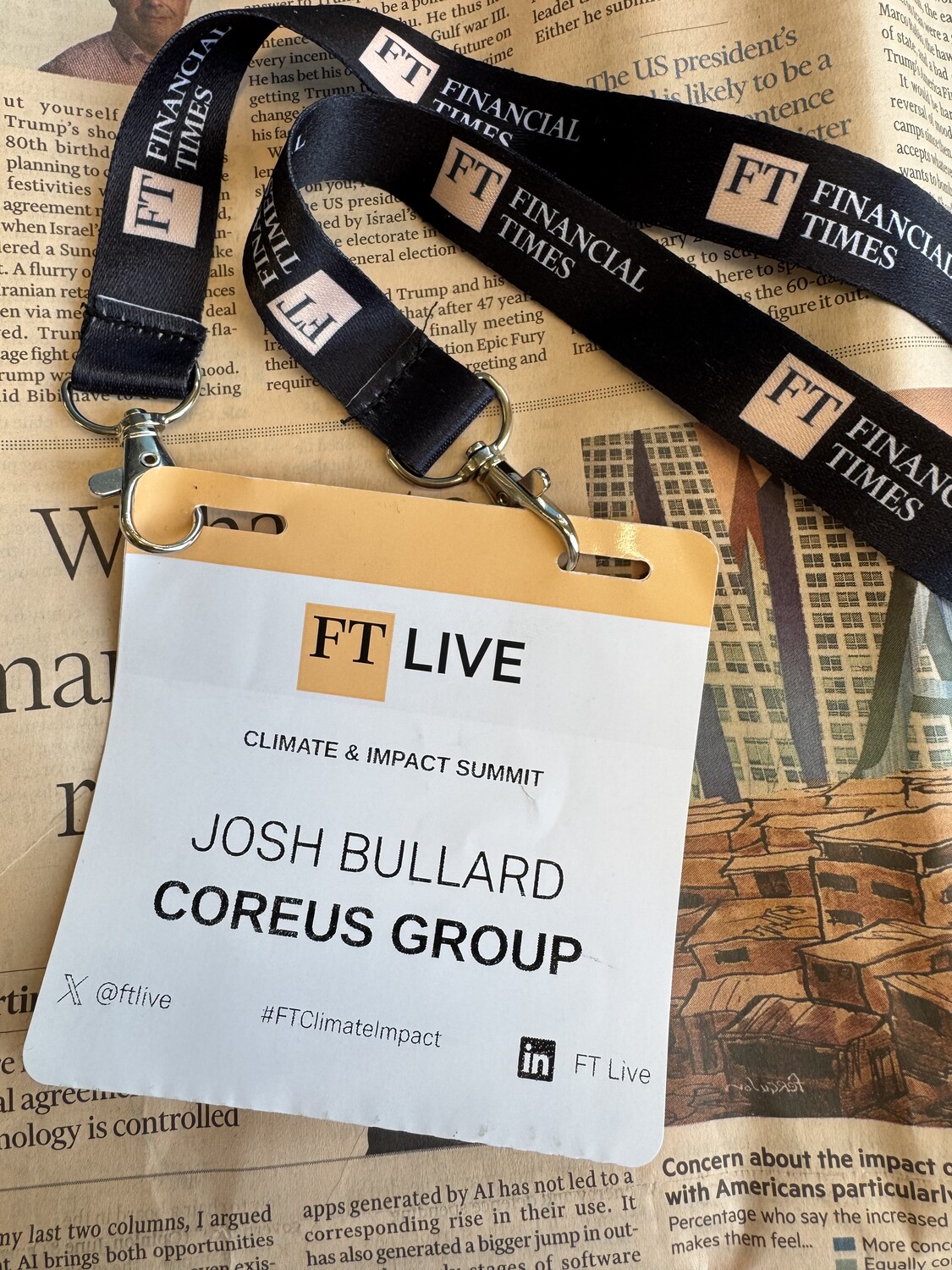
As the UK experiences another heat wave… thought I’d share a few reflections from last week’s Financial Times Climate & Impact Summit in London.
The theme was clear; climate risk is moving from “ESG issue” to core investment, infrastructure and resilience underwriting.
1. Nature markets evolve
Tony Goldner of Taskforce on Nature-related Financial Disclosures (TNFD) and Jacco Minnaar of Triodos Bank framed nature not as philanthropy, but as a balance sheet and resilience question.
- Nearly 75% of euro area corporate lending is to companies highly dependent on at least one ecosystem service
- The biodiversity finance gap is commonly estimated at c.$700bn per year
- TNFD now has more than 700 adopters, including financial institutions representing over $22tn AUM
- Around $30 is still spent on nature-negative activities for every $1 invested in nature protection
For developers and funds, that means biodiversity, water, heat, soil, flood resilience and supply chain fragility need to move closer to the investment committee, rather than a sustainability appendix.
The opportunity is also becoming clearer; nature restoration often needs 20 years+ of capital, ideal duration for infra and real estate funds. Unresolved question is still who pays for the resilience outcome.
2. Carbon markets are maturing, but pricing resilience is harder
The EU’s carbon pricing model has been one the more effective market-based mechanisms; technology-neutral, rules-based and increasingly material to public revenues. 30% of global emissions are now covered by some form of carbon pricing, with the ETS having materially contributed 50% of industrial and power sector decarbonisation while raising significant public revenues (over €250bn).
Biodiversity and resilience remain more complicated. Voluntary nature markets have not yet created the confidence or demand needed at scale (a mere $8m invested to date globally!). UK Biodiversity Net Gain is an important test case, but the broader question remains; can we create investable cashflows from avoided loss, avoided disruption and long-term ecological value?
For real estate, terminal value is going to be harder to defend where climate and nature costs are accelerating.
3. The grid as key development constraint
Kayte O’Neill O’Neill at National Energy System Operator and Chris Stark CBE, leading the UK’s Clean Power 2030 mission, both pointed to the same reality; grid access is no longer a back-office utilities issue, it is becoming a gating item for growth.
Kayte noted that the connections queue had reached around 4x the capacity needed by 2030 and 2x the capacity needed by 2050. Reform has led to model shifting from “first come, first served” to “ready and needed”. That is critical for renewables, batteries, data centres, EV charging, industrial electrification and major regeneration.
For developers, this means power strategy needs to move much earlier in site selection, planning and underwriting. “Can we get power, when, on what terms, and with what flexibility?” is now as important as transport, land value and planning risk.
4. Flexibility in the grid is the most significant opportunity but structural barriers remain
Greg Jackson of Octopus Energy made his typically compelling case that the future electricity system is not just about more generation, but more flexible consumption.
The emerging system will be more decentralised, more local and more dynamic. The challenge is that our current market still tends to reward putting power onto the grid, rather than rewarding when and where that power is produced, stored or used.
That matters because consumption patterns are changing. EVs, heat pumps, batteries and smart buildings can shift demand, but we do not yet have sufficient localised price signals to fully value that flexibility.
Octopus have access to c.3GW of shiftable power through EVs and heat pumps. Scaled nationally, the opportunity could be much large, potentially making flexible demand a core part of the electricity system rather than a marginal add-on.
Vehicle to grid (V2G) is also an underappreciated opportunity. As bi-directional charging standards and commercial models mature, EVs could become distributed grid assets rather than just new sources of demand. For developers, landlords and infrastructure investors, that has real implications; car parks, depots, residential schemes and mixed-use assets could all become part of the flexibility market.
The key question is not just “how much power does this asset need?” but “when does it need power, what can it shift, and can it help the wider system?”
Typical European grids may be only around 11% utilised, thus the opportunity is not just to build more infrastructure, but to use the infrastructure we already have much better.
For built environment owners, that points to a different kind of asset management: buildings as flexible energy participants, not just passive consumers.

5. Data centres are exposing the limits of old infrastructure planning
The AI discussion, including Thomas Spencer International Energy Agency (IEA) and David Patterson of Google, reinforced the scale of the challenge.
For data centres, speed to power can matter more than the absolute cost of power. Thomas also noted that, for frontier AI facilities, GPUs are by far the largest cost component, meaning the levelised cost of energy is not always the main constraint. Permitting, network access and time to connection can be more decisive.
Ana Troncoso Ceola of ABB highlighted the retrofit opportunity too: a large proportion of Europe’s data centre stock is inefficient, and better cooling and system optimisation can potentially release meaningful capacity.
That is a useful reminder for the wider built environment. Retrofit is not just a carbon story. It is about capacity, resilience, and increasingly, energy security.
6. “Mission-led growth” needs delivery architecture
Mariana Mazzucato’s keynote brought the macro point back to governance: we do not just need to fix market failures; we need to shape markets around clear missions.
Her “common good” framework; purpose, co-creation, shared learning, reward-sharing and accountability, feels highly relevant to infrastructure and real estate. Public-private partnership cannot just mean public de-risking and private upside.
The SDG numbers were sobering: 18% of SDG targets are going backwards, and around 50% are moving too slowly. The point was not that capital is absent, but that public and private capital need to be aligned around outcomes.
My main takeaways:
The built environment is moving into a phase where climate resilience, nature, grid capacity and energy flexibility are not separate sustainability themes. They are becoming core determinants of value.
The assets that win will be those that are:
- Lower carbon
- Less exposed to physical climate risk
- More grid-aware
- More flexible in demand
- Better integrated with nature
- Easier to insure, finance and operate over the long term
- Climate risk is no longer just about reporting. It is about investability.